BACnet: a building-level integration protocol
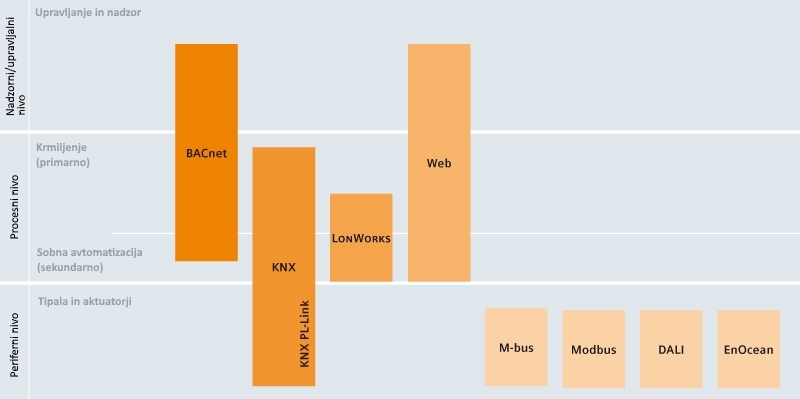
BACnet is designed for building automation and is commonly used to exchange objects, properties and events between controllers and supervisory systems. It can be a strong choice for integrating HVAC plants and BMS.
Modbus: equipment and measurement interfaces
Modbus is widely supported by electrical meters, controllers, drives and other field equipment. Integrators must understand the register map, data type, scaling and endianness rather than relying on the protocol name alone.
KNX: room and building functions
KNX is widely used for lighting, shading, room controls and other distributed building functions. Engineering requires a consistent group-address and commissioning strategy.
Can they be combined?
Yes. A common architecture uses KNX for room functions, Modbus for meters and equipment, and BACnet to integrate data with the building-management layer. Gateways or controllers translate between the systems.
How to make the choice
Start with functional requirements, point counts, cybersecurity, maintenance and existing infrastructure. Avoid adding protocol complexity where it provides no user benefit.
Functional comparison at project level
| Question | BACnet | Modbus | KNX |
|---|---|---|---|
| Where is it commonly used? | BMS/CNS and HVAC plant integration | Meters, drives, industrial equipment | Room functions, lighting, blinds, HVAC room controls |
| What does the engineer configure? | Devices, objects, properties, services and networking | Register maps, addressing, scaling and data formats | Group addresses, devices, applications and commissioning |
| What should be verified? | Supported services, object lists, Device IDs, BBMD/SC | Register documentation, byte order, write permissions | Application compatibility, group-address structure, topology |
A building-level integration example
Consider an office building with Siemens controllers for the air handling units, electrical meters exposing Modbus registers and KNX devices controlling lights and blinds. A supervisory BMS can combine the important values using suitable gateways and controllers. The building manager sees relevant alarms and trends while the field networks retain their functions locally.
Common design mistakes
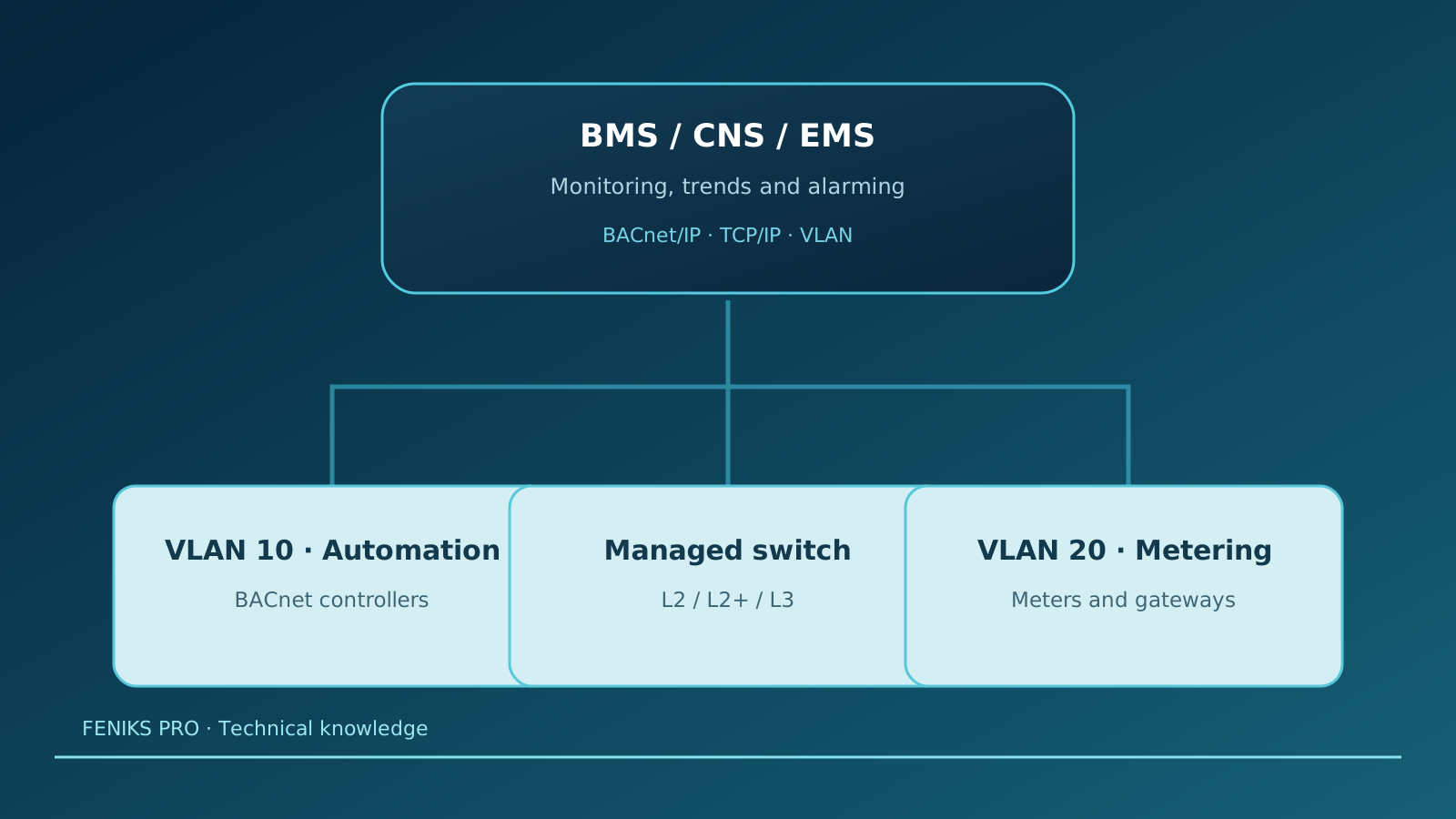
Do not select a protocol before defining required functions and points. Avoid importing every possible register into the BMS without asking how the operator will use it. Specify how devices behave during network outages. On shared IP networks, agree VLANs, addressing, firewalls and service access with the IT team. A documented and tested interface matters more than an attractive protocol label.
Comparison by practical task
| Requirement | Common choice | Why |
|---|---|---|
| Central BMS integration of HVAC controllers | BACnet | Building-oriented objects, properties and services |
| Reading a meter or a frequency converter | Modbus | Widely available equipment interfaces and register maps |
| Room lighting, blinds and scene control | KNX | Distributed room functions and standard engineering workflows |
| Addressable luminaire operation | DALI via a suitable gateway | Specialised digital lighting control |
Why mixed architectures are common
A real building might use BACnet for central HVAC automation, Modbus for energy meters and drives, KNX for lighting and blinds, and DALI within the lighting system. The BMS can present these through suitable interfaces, but point mapping, network routing, access control and failure handling must still be engineered.
Selection pitfalls
A supported protocol name does not guarantee that the required measurements can be read or that the desired setpoint can be written. Ask for object and register lists, communication limits, a demonstration of key functions and a documented integration acceptance test.
 Network switches in building automation: L2, L2+ and L3 for BACnet/IPRead article ↗
 Five building automation mistakes that cost investors moreRead article ↗
 EPBD 2026: implications for BMS, EMS and building automation in SloveniaRead article ↗