01
Sensors and room units
Temperature, humidity, pressure, air quality and occupancy information supports HVAC operation and comfort.

Accurate measurements and correctly selected actuators are essential for stable, efficient control.
Accurate measurements and correctly selected actuators are essential for stable, efficient control.
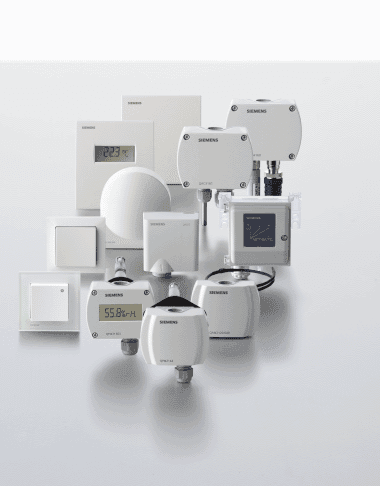
Temperature, humidity, pressure, air quality and occupancy information supports HVAC operation and comfort.
Control valves, damper actuators and other field devices convert automation commands into physical operation.
Correct installation, range, accuracy and communication must be matched to the building application—not just to a product catalogue.
A controller cannot perform well if sensors provide misleading measurements or if an actuator is incorrectly sized. Field devices should be robust, easy to install and serviceable under the actual operating conditions.
Two-way and three-way valves control or mix hydronic flows; pressure-independent designs suit applications where varying differential pressure would affect conventional control. Damper actuators regulate air paths in HVAC equipment, while specialised models meet defined fire- or safety-related requirements. The correct torque, stroke, signal type and fail-safe behaviour are application-specific.
| Equipment category | Product-family examples |
|---|---|
| Temperature sensors | QAA, QAM, QAE, QAD, QAP, QAC |
| Two- and three-way valves | VVF, VVG, VXG, VXF |
| Magnetic control valves | MXF461, MXG461 |
| Valve and damper actuators | SAX, SAS, SAL, GBB, GCA, GDB, GEB |
| Room controllers and units | RDF, RDG and earlier RCC/RAB families |
| Utility and heat meters | WFW, WFC, WFM, WFN and UH50 families |
These are examples from archived product documentation, not a current availability or compatibility guarantee. Always verify the exact model, revision, electrical connection, communication interface and replacement options against current manufacturer documentation.
Where supported, KNX or Modbus-capable devices can reduce the need for separate analogue signals and provide additional diagnostic values. However, bus topology, power supply, addressing and commissioning procedures must be considered from the beginning.